Architecture Where the Ground Ends
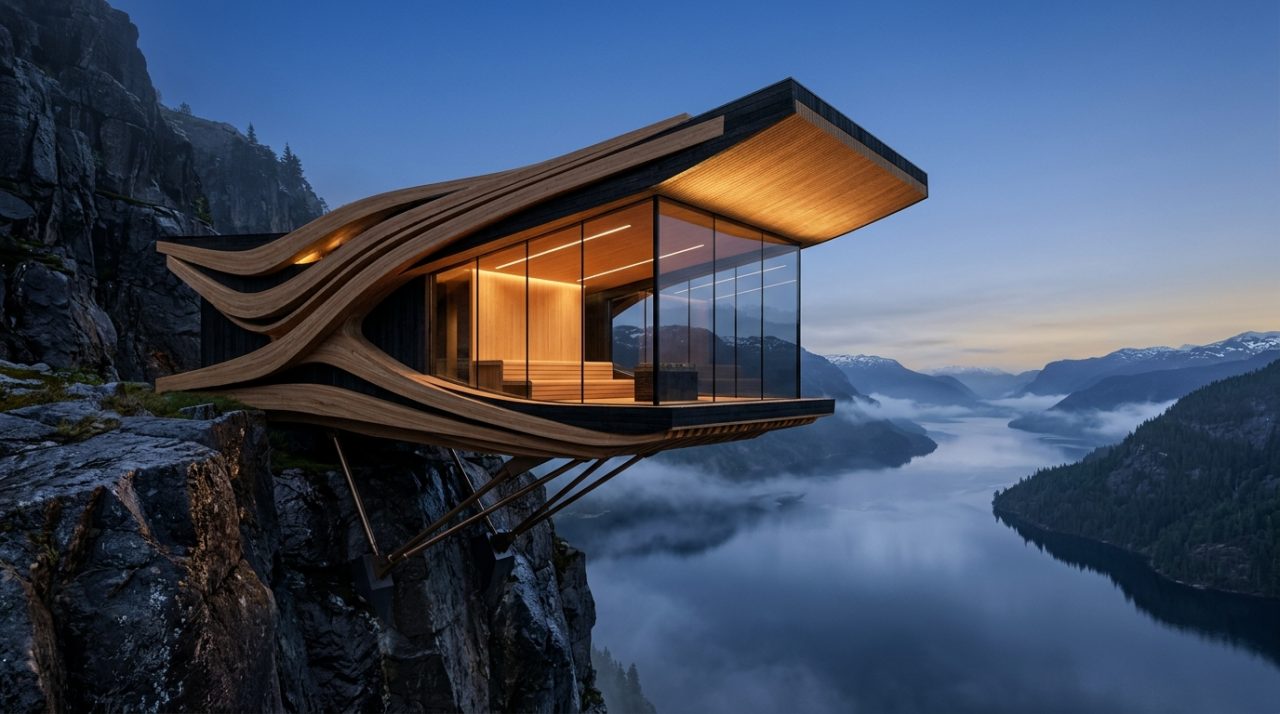
Across international idea competitions—from the radical theoretical prompts of the Nisshin Kogyo Architectural Design Competition exploring the union of "sky" and "house" to Canadian speculative wilderness studios—the cantilevered pavilion remains one of architecture's most enduring archetypes. Anchored lightly to granite bedrock while projecting out over mist and water, it dramatizes the ancient dialogue between shelter and exposure.
Material Restraint Makes Fantasy Believable
The most persuasive un-built sky pavilions rarely rely on sci-fi chrome or incomprehensible geometry. Instead, they achieve wonder through extreme tectonic clarity:
- Deep Structural Fins: Tapered laminated timber beams transfer tension transparently back into a compact stone core, letting the viewer understand the cantilever intuitively.
- Thermal & Luminous Warmth: Against cobalt northern twilight, warm 2700K interior timber soffits transform the pavilion into a quiet lantern rather than a cold glass box.
- Zero-Scar Site Stewardship: Pin-foundation anchors touch only a fraction of the cliff edge, preserving lichen, rainwater runoff paths, and native pine roots below.
Even when a fantasy pavilion is never meant to be built on a fragile shoreline, studying its structural efficiency frequently yields real-world breakthroughs in lightweight modular framing and prefabrication.